
TWMS is a music making club where participants have three weeks to compose and perform a short piece of music.
Round 6 (November 7 — November 27)
Create a piece inspired by an animal.
A barn owl, a barnacle, a cockatoo, a caribou.
Round 5 (October 17 — November 6)
Create a piece that sounds sweltering.
Make it hot, make it sluggish, make it fire, make it pop.
Ben, “Pressure”
I set out to make a piece that sounded oppressive and disorienting, that sounded like the feeling of trying to do something while dehydrated and exhausted. I build up background texture from ad-hoc samples — heavy breathing, sloshing water, a vacuum cleaner — and then slowly build up a drum track, only to have it collapse from exhaustion before it could really get going.
Rowan, “Pimenta Biquinho”
I was inspired by hot locales, specifically South America, and I explored bossa nova and latin grooves in this short piece. I used an online Mario Music Maker as my ‘medium’ as I was also inspired by how video games often have levels that are themed around a specific environment with music written specifically to help create the setting.
Round 4 (September 26 — October 16)
Create a piece that uses a pitch collection of only five notes.
Any pitched sounds in the piece must be one of the five chosen notes, in any octave.
Alex, “Winter”
I didn't have much of a concept of what I wanted the piece to be when I started, it developed emergently as I worked on it. I used this piece as an opportunity to learn more about creating music on the Deluge.
Ben, “Ninety minutes”
I started with the slower, layered melodies at the start of the piece, using a five note pitch colllection of C, C#, D#, G, and A#, but it wasn't until I sampled recordings of automatic telephone systems that the piece really started to come together. My aim was to create a high-energy piece with frantic drum-and-bass style drums.
Rowan, “Plexure”
Noun. The act or process of weaving together. Inspired by pulse music of Steve Reich this work features a piano line recorded at three slightly different tempos. The recordings separate further and further before coalescing and reforming fleetingly near the end.
Round 3 (September 5 — September 25)
Create a piece that is based on a work of art.
No further details.
Ben, “Raglan”
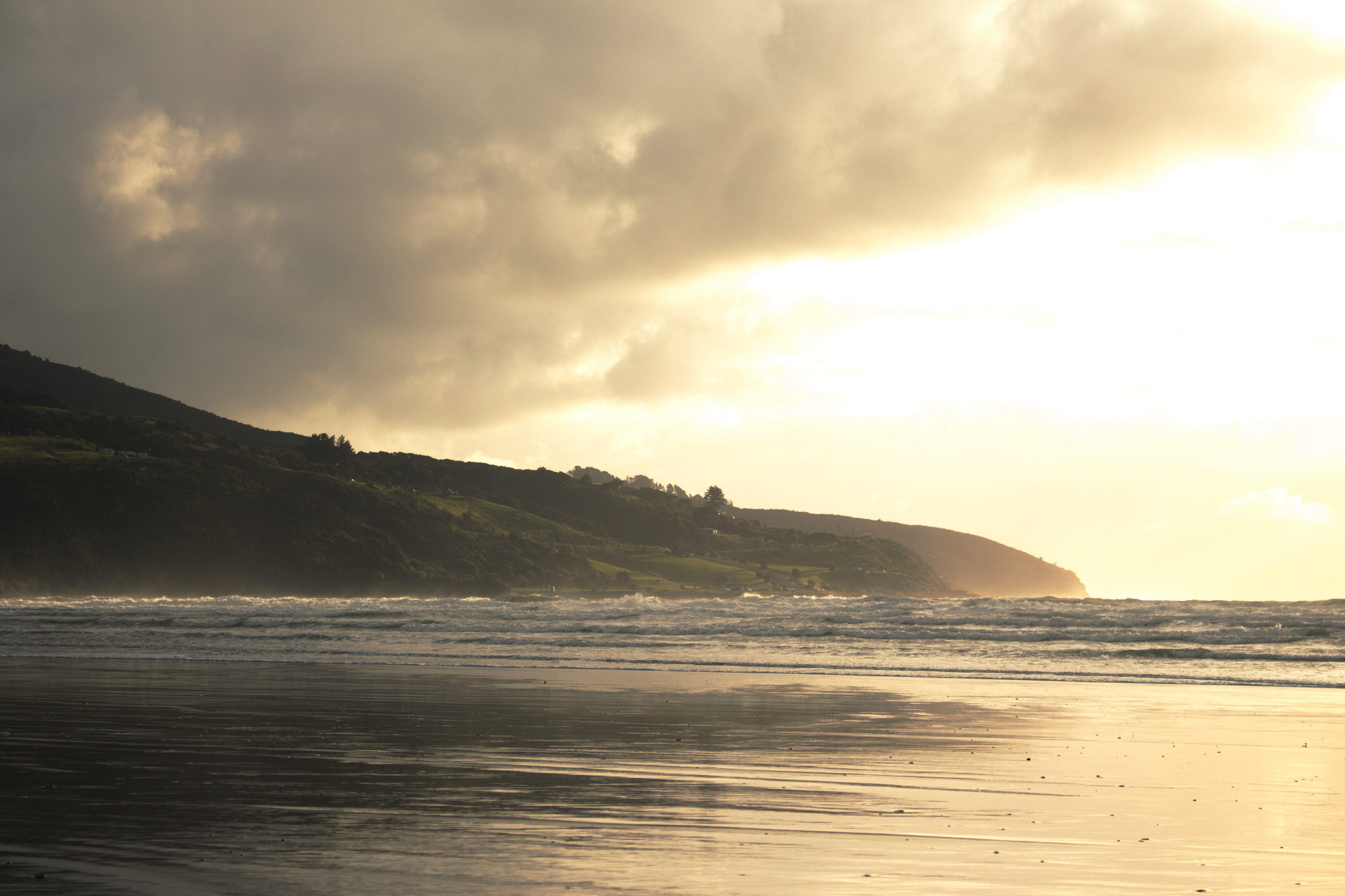
I based this piece on a photograph I took during an evening in 2017 which holds a lot of meaning to me. I chose to place notes loosely, allowing them to cluster and drift instead of fixing them to a strict meter. The lulls between groups of notes help draw attention to the shifting beat of the wind and the waves, the sound of which is procedurally generated from white noise. This piece represents to me the important things in life.
(click to show image)
Round 2 (August 8 — August 28)
Create a piece using only untuned percussion.
Any percussion can be used here, as long as it can't carry a tune. Bonus points for walking around your kitchen whacking on random objects. Everything's a drum.
Alex, “War of the pots”
A short piece composed of a pot, oven door, toaster, pepper grinder and a spoon. Go forth and conquer the world with chaos and creativity.
Ben, “Third degree”
In this piece I experimented with the use of fills between sections to add variety and cohesion to what would otherwise be a series of isolated loops. I constructed the piece from the same set of home-sampled kitchen recordings as Alex.
Rowan, “Frog Rock”
Making full use of the Deluge kit sample library this piece experiments with texture and flow with suitably froggy sounds created by ratchets.
Round 1 (July 18 — August 7)
Create a piece using the whole tone scale and an odd time signature.
The whole tone scale consists of notes that are all one whole tone apart. There are only 2 possible ways of writing the whole tone scale (disregarding the various enharmonic respellings): C D E F# G# A#, and C# D# F G A B. This scale emerged in western music in the late 19th/early 20th centuries, and is used most often in film music. It is often use to create an idea of expansiveness in pieces about the ocean and space. This is a favourite scale of Debussy's, and can be heard in La Mer and Prélude à l'après-midi d'un faune.
Odd time signatures refers to any time signature that does not fall under the simple or compound categories. Any time signature where the numerator is not divisible by 2 or 3 is an odd time signature. As they do not fall into compound or simple structures, odd time signatures allow composers to be playful with beat groupings. For example 5/4 time can be beat as 2+3 crotchets, or 3+2 crotchets, and the grouping can also be changed from bar to bar. Odd time signatures emerged in the 20th Century, and are a popular feature of jazz music. Composers that are well known for their use of odd time signatures include Thelonius Monk and Béla Bartók.
Ben, “Insurance write-off”
I wrote my piece in 5/4, using percussion hits on off-beats as a ploy to distract from the awkwardness of the extra beat per bar. I drop all pretences by the time the crash cymbals come in though, and I really lean into the time signature with the drums.
Rowan, “Dropped Stitch”
Inspired by Norman Dello Joio's Suite for Piano and the swung 5/4 rhythm of Nick Drake's River Man. The piece is comprised of an A section with a striding bass line that emphasises the spatiality of the whole tone scale, and a B section which features pitch rotation.